


WEAVING A STRONGER MAT: PACIFIC PROGRESS ON DISABILITY-INCLUSIVE BENEFITS
Weaving a stronger mat: Pacific progress on disability-inclusive benefits
By Shirleen Ali, GEDSI Adviser, P4SP
My grandmother, Nena as we called her, came from the island of Rotuma, and among the many things she was, she was a mat weaver. She wove the mats we used every day, and she wove the apei, the fine white mats that are brought out for special occasions. I can still picture her bent over her work, weaving the intricate details strand by strand.
A mat like hers depends on every one of those strands. Where one is missing or weak, the gap shows and the whole mat is less able to bear weight. I often think of social protection in this way. Our families, faith-based organisations, and communities have always held one another up, and persons with disabilities have long been part of those circles of care.
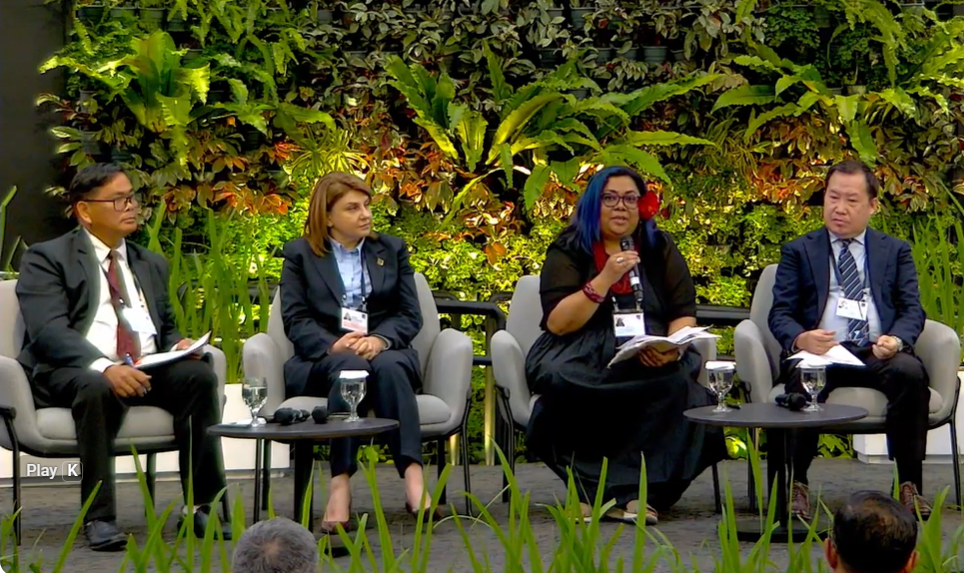
That image stayed with me at Asia-Pacific Social Protection Week 2026, where I joined a panel on disability benefits in the session Advancing Autonomy: Disability-inclusive Social Protection. Our moderator, Charles Knox-Vydmanov, Social Protection Specialist at UNICEF, opened by reminding us how far the conversation has travelled. “If we look back ten years, we were still asking what disability-inclusive social protection meant and what the Convention on the Rights of Persons with Disabilities required in practice,” he said. There are now far more resources, tools and training available, and, as he noted, countries are putting that thinking into practice.
The Pacific has been part of that shift. Since around 2015, disability benefits have been introduced in Tonga, Fiji, Tuvalu, Kiribati, Naoero, Samoa, Palau and the Marshall Islands. The Cook Islands led the way much earlier, introducing its benefit in the 1960s. For a region of small populations spread across vast stretches of ocean, this is a remarkable record, and it reflects deliberate choices by Pacific governments to invest their own resources in their people.
Kiribati offers a strong example. The government has reinvested revenue from fishing licences, drawn from the same ocean that sustains I-Kiribati life, into an integrated package of unemployment, old-age and disability benefits. Its most recent household income and expenditure survey showed that poverty fell by about 75 per cent between 2019-20 and 2023-24 because of this investment in social assistance.
Other countries are building on their benefits in ways that suit their own context. Naoero has complemented its disability benefit with programs for children with disabilities and a home-modification program for persons with disabilities and older persons. During the ongoing Middle East fuel crisis, Tonga provided top-up payments to people receiving old-age and disability benefits, and Fiji distributed top-ups to all people receiving benefits via their 6 core schemes, helping households to manage rising costs.
These measures sit alongside the traditional systems that have always carried our communities, and they strengthen them. Throughout our island communities, generosity and reciprocity have long been held among the highest virtues, and these values are woven into who we are as families and communities. When a family marks a birth, a wedding or a death, relatives arrive carrying food and mats, often the very kind my Nena wove, so that no household carries the occasion alone. Social protection builds on these values and its benefits reach well beyond household income. It helps families care for one another, strengthens the bonds of community and allows us to live and work better together.
Pacific governments have built strong social protection foundations by global standards, with high coverage across much of the region. Governments are also working steadily to meet their commitments under the Convention on the Rights of Persons with Disabilities, working to ensure that services are more inclusive, accessible and responsive to the needs of all citizens.
Fiji provides a good example of this progress. Its investment in digital transformation is strengthening the systems that underpin the social protection programs, the often unseen administrative and delivery mechanisms that people rely on every day, with the aim of making services more accessible for everyone who uses them.
Equally important has been the meaningful engagement of organisations of persons with disabilities (OPDs) throughout this process. They are trusted channels within their communities, and they belong on the mat alongside government from the very beginning of system design and implementation.
There is still work ahead, and OPDs continue to advocate strongly for it. The Pacific Disability Forum, with support from Partnerships for Social Protection (P4SP) has been consulting OPDs across nine Pacific island countries to inform a new guidance note on disability-inclusive benefits. The message from those conversations has been clear and consistent. Disability benefits are a right, and they should be established in legislation so that they are sustained in national budgets over time.
Adequacy also remains a concern, as disability-related costs can quickly consume the support available. One wheelchair user told us that hiring an accessible vehicle to travel to hospital or to take part in social activities costs AUD 100 a day. Almost a third of the fortnightly benefit can disappear in a single day. Geography, accessibility barriers and complex application processes continue to keep some people from the support they are entitled to.
Strong disability-inclusive social protection therefore calls for a holistic approach. Cash is critical but it must be complemented by services and in-kind benefits. That combination reflects the Pacific’s own strength, where community-based support is reinforced by inclusive, rights-based government systems.
Knox-Vydmanov closed the panel on a similar note, observing that countries across the Pacific and Asia are increasingly moving from discussion to implementation. “Progress requires collaboration among governments, international organisations, civil society, organisations of persons with disabilities, researchers and other partners,” he said. “The work remains complicated. However, there are pathways forward, and countries are finding solutions.”
I think often of my Nena bent over her mat, splitting each pandanus strand before she wove it into place. Across our region, the mat is still being woven. Many strands are already in place, held there by governments, OPDs, families and communities who have long understood that everyone has a place among us. Our shared task is to make sure each strand holds, so that persons with disabilities across our region can live with the autonomy, dignity and security that are theirs by right.