


CONNECTING THE DOTS: SOCIAL PROTECTION FOR CLIMATE ACTION IN THE PACIFIC
Connecting the dots: social protection for climate action in the Pacific
Written by Sayanti Sengupta (Independent consultant at Partnerships for Social Protection (P4SP), and Marita Manley and Sangeeta Mangubhai (Principal Consultants, Talanoa Consulting) with support from P4SP.
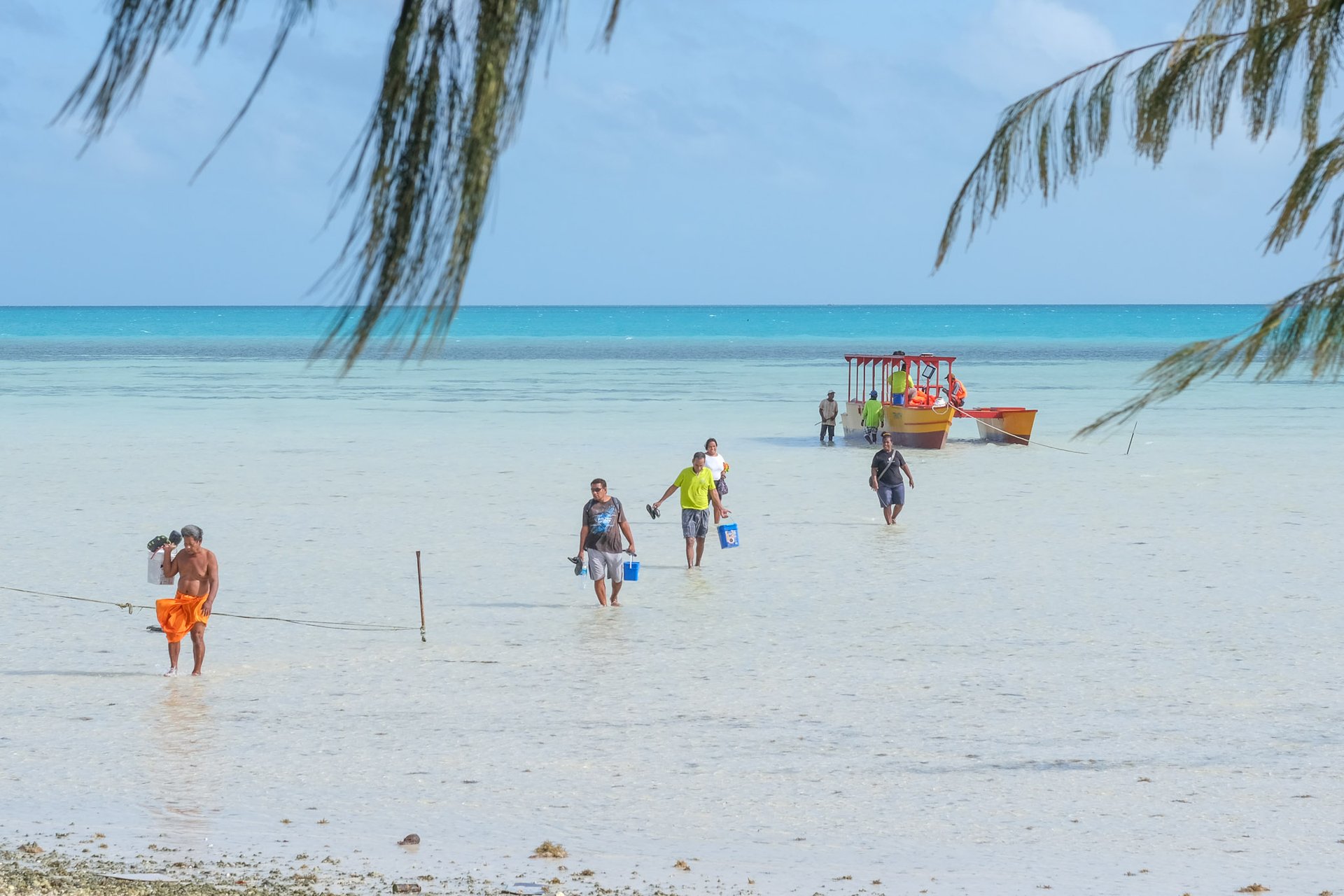
Passengers wade through shallow water to return to shore after a boat trip in Kiribati. Photo by P4SP/Sarah Francis.
Emerging experience from the Pacific shows how social protection can be a critical tool for strengthening community resilience. Opportunities exist to turn experiences and pilots into long-term, systematic and routine interventions by investing in deliberate collaboration, continuing efforts to strengthen national social protection systems, and securing dedicated financing to support them. In this blog, we highlight the region's progress in connecting social protection and climate action, and explore opportunities to build on current momentum.
What our recent study shows
Social protection already contributes to climate resilience in the Pacific, and its potential extends well beyond emergency assistance after disasters. The recently published P4SP report, Social Protection and Climate Change in the Pacific, identifies opportunities for social protection to support shock response, address loss and damage, strengthen resilience, enable climate change adaptation, and support climate change mitigation and a just transition. The extent to which these functions have been developed varies significantly across the Pacific, and there are encouraging examples to build on.
The clearest operational evidence is in responding to shocks. Countries including Fiji and Tonga have used existing social protection programs and delivery systems to provide additional assistance following disasters for the last decade.
Routine social protection programs, such as elderly pensions and disability benefits, are also being strengthened and expanded, helping to reduce the underlying vulnerabilities that shape people's ability to cope with climate impacts.
The study also documents initiatives that promote adaptation by connecting income support and employment with livelihood diversification, ecosystem restoration and community resilience (e.g. through planned Blue Economy Initiatives in Solomon Islands), although many remain small-scale or project-based.
Livelihoods in island economies are often dependent on maritime transport, and whilst the uptake of renewable energy is accelerating, transitioning to a fossil-fuel-free future will impact incomes and jobs. Support for people affected by climate transition policies and links between social protection and emissions reduction are less developed. However, these areas are likely to become increasingly important as countries transition away from fossil fuels or introduce restrictions on commercial fishing and logging, which might result in associated impacts on livelihoods.
The report emphasises opportunities to deliberately design and link social protection interventions to address climate change. This will require systematic efforts and greater collaboration between social protection and climate actors who often work separately, with different mandates, terminology, and financing arrangements. Shared objectives do not automatically produce shared programs. Moving from recognising that social protection is relevant to deciding how to use it will require sustained engagement, joint design, co-financing and investment in implementation.
What discussions at pre-COP31 reveal
The pre-COP31 discussions in Fiji brought this gap into sharper focus. Reaching vulnerable communities and improving climate finance access for the last mile were at the heart of these conversations, yet explicit consideration of social protection remained largely confined to shock response. One explanation for this may be that technical language is acting as a barrier to shared understanding. For many in the climate change space (and probably more broadly) in the Pacific, the term social protection is unfamiliar and often confused with other terms and concepts, including safeguarding, social inclusion and protection more broadly. This obscures the understanding of social protection’s core function: providing income security and support through concrete policies and programmes.
Nevertheless, discussions at pre-COP31 revealed an interest in understanding how social protection instruments, delivery systems and communication channels could support climate action. In addition, there was also honest acknowledgement of the sectoral silos that exist and can prevent sectors from developing solutions together.
And this is why it is important to have social protection practitioners in the conversations that shape climate policies, programmes and financing arrangements, and to engage them early enough to meaningfully collaborate in cross-cutting, multi-sectoral programmes that are ambitious yet achievable.
A contribution from Rozia Bi, the National Coordinator for Social Protection Reforms for Fiji's Ministry of Women, Children and Social Protection, captures the ambition:
“We have shown that social protection works. When we go to COP31 and talk about reaching vulnerable people, let’s include climate resilient social protection approaches.”
Several speakers noted the challenge of accessing global climate finance mechanisms and their insufficient responsiveness to the needs of countries in the Pacific. Reflecting a Pacific pre-COP discussion paper, participants called for more programmatic and budget support responses to move away from highly projectised nature of climate finance (with high transaction costs and slow approval processes). Sainimili Tawake, CEO of the Pacific Disability Forum (peak body for organisations for persons with disabilities in the Pacific), emphasised the need for climate finance to be more inclusive of persons with disabilities and responsive to their needs.
Pre-COP31 demonstrated a growing interest in understanding how social protection instruments, delivery systems and communication channels can support inclusive climate action. It acknowledged the need for working across sectors, bridging the separate institutional and financing arrangements of social protection and climate change.
Building on Pacific strengths
There are practical examples across the Pacific that offer valuable insights into how social protection and climate action can work together.
Fiji’s anticipatory action framework already connects forecast triggers with existing social protection registries and payment channels. Its design allows government to pre-finance cash transfers and receive reimbursement from external partners, enabling payments within 24 hours of a trigger. It demonstrates the value of connecting climate forecasting, financing arrangements and established social protection delivery systems. It also highlights how pre-agreed financing sources, operational procedures and clear institutional responsibilities can help ensure assistance reaches affected households quickly.
Fiji's Nationally Determined Contribution 3.0 provides another entry point for long-term climate action. It explicitly connects adaptation with enhanced social protection and identifies social protection systems among potential national financial modalities for responding to loss and damage. The next step would be to translate that national commitment into costed arrangements: which institutions will work together, who will receive support, what assistance will be provided, and how it will be financed.
The Pacific Resilience Facility is already funding community-level climate resilience projects, offering an important Pacific-led response to demands for more accessible climate finance. Alongside these investments, there is an opportunity to explore how national social protection systems can complement community and regional initiatives, connecting locally led resilience activities with established mechanisms for delivering assistance directly to households.
Kiribati’s proposed ex-post reimbursement windows within existing multilateral climate funds (such as the Green Climate Fund and the Adaptation Funds), presented by the Minister for Women, Youth, Sports and Social Assistance at Pre-COP 31, offer another approach worth exploring.
The published proposal focuses on governments financing urgent resilience works upfront through contingency reserves or bridge financing, then seeking reimbursement following verification. Extending this principle to eligible social protection assistance could enable governments to use national delivery systems to support affected households without waiting for lengthy funding approvals. Subsequent reimbursement could replenish the resources used, helping to make this approach more sustainable. Such an approach would require access to upfront financing, clear eligibility and verification arrangements, and predictable reimbursement timelines. Exploring its feasibility would require deliberate dialogue between ministries responsible for social protection, climate change, disaster management and finance, alongside the relevant multilateral climate funds.
The Pacific’s ongoing progress demonstrates that social protection has an important and increasingly recognised role to play in climate resilience. By continuing to build on Pacific-led initiatives and strengthening connections between existing systems, institutions and financing, countries can better support communities to prepare for, respond to and recover from shocks, and reduce climate impacts.
This blog was first published on socialprotection.org and is republished here with permission.