


BUILDING CLIMATE RESILIENCE IN THE PACIFIC THROUGH SOCIAL PROTECTION
Building climate resilience in the Pacific through social protection
Pacific island countries are among the most climate-vulnerable in the world. Rising sea levels, stronger cyclones and other hazards are placing increasing pressure on communities, governments and economies.
As these risks intensify, policymakers are looking more closely at how social protection systems can help households prepare for, cope with and recover from climate-related shocks.
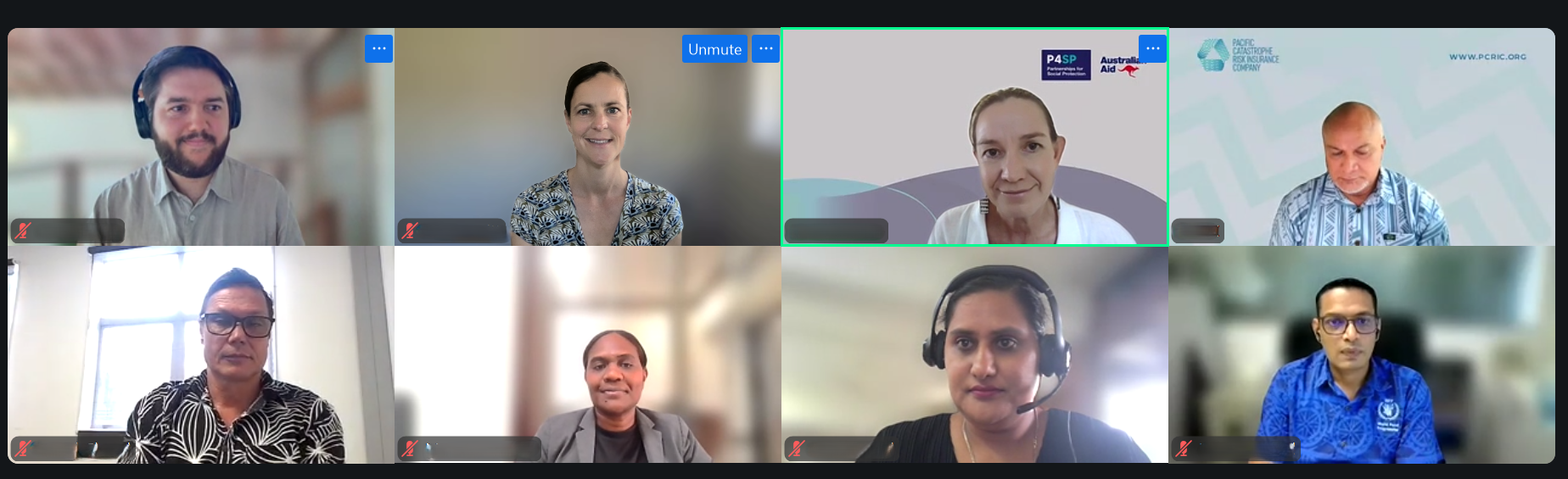
This was the focus of a virtual learning episode, The future of climate resilient social protection and disaster financing, hosted by the Pacific Islands Forum on 6 November 2025. It was the third in a series of learning events on social protection and climate change, presented by Partnerships for Social Protection (P4SP) and the UN World Food Programme (WFP).
Experts from governments and international organisations discussed how social protection, disaster risk financing and insurance mechanisms can work together to strengthen resilience across the Pacific.
Rethinking social protection for a changing climate
Social protection refers to policies and programs that are aimed at protecting people against poverty, vulnerability and social exclusion throughout their life.
But climate change is creating new pressures that require systems to adapt, explained Jesse Doyle, Senior Social Protection Specialist with P4SP.
“Existing systems have primarily been designed with life cycle risks rather than climate risks in mind,” he said. “And we know climate change is already increasing hardship and vulnerability in the region and that's predicted to significantly worsen.
“With that, both government-led and community and family-based systems will be put under immense strain.”
This underscores the need to consider how social protection systems can also respond to shocks and the longer-term transformations caused by climate change.
The role social protection can play
Social protection systems can support climate resilience in five ways, highlights the Social protection and climate change in the Pacific report.
“Social protection helps countries respond to climate shocks such as cyclones or floods by providing direct support to vulnerable individuals and households to manage (rapid- and slow-onset) disaster events, and to reduce vulnerabilities before disasters occur by strengthening livelihoods and economic security,” said Doyle.
“There are also opportunities for social protection to enable adaptation options, reduce greenhouse gas emissions or promote carbon sequestration, and assist the green transition.”
Harnessing the power of social protection for climate resilience depends on having robust systems.
“At the very heart of climate-resilient social protection is this agenda around strengthening core social protection systems,” Doyle said.
“This is something that Pacific countries are already investing heavily in.”
Vanuatu’s push for adaptive social protection
Vanuatu faces one of the highest levels of disaster risk in the world.
Disasters represent one of the country’s most significant development challenges, explained Maeva Magmui, Principal Sector Analyst (Governance and Leadership) with the Department of Strategic Policy, Planning and Aid Coordination, Government of Vanuatu.
“The country regularly experiences tropical cyclones, floods, droughts and geophysical hazards including volcanic eruptions, earthquakes and tsunamis.”
In response, the Vanuatu Government developed an adaptive social protection policy in 2024, following a national policy dialogue with the World Bank.
“The policy aims to strengthen protection for vulnerable communities and improve the country’s ability to respond to shocks.
“We want to protect vulnerable populations from falling deeper into poverty due to disasters and shocks and build resilience by providing timely and appropriate support,” she said.
Currently, Vanuatu does not have a government-led safety net system. However, Vanuatu is developing a National Comprehensive Social Protection Policy to establish how government-led social protection will reduce risk, strengthen resilience, and support individuals and households.
“Moving forward, we want to strengthen collaboration between stakeholders, develop basic architecture with digital payments, secure disaster risk financing, and continue working with our partners for capacity and infrastructure support,” said Magmui.
Insurance and rapid disaster financing
Disaster risk insurance is another important part of the resilience toolkit.
The Pacific Catastrophe Risk Insurance Company (PCRIC) was established by Pacific leadership in 2016 to help countries access rapid financial protection support after disasters.
Aholotu Palu, CEO of PCRIC, provided an overview of PCRIC’s role in helping Pacific island governments cope with shocks. “There are three phases of a disaster response: relief, recovery and reconstruction,” he said. “Immediately after the disaster, we provide cash resources for immediate relief.”
PCRIC works with governments to design insurance policies based on their most significant risks, such as cyclones or earthquakes. When disaster triggers are met, payouts can be made quickly.
“We provide resources to countries immediately within 10 or 14 days, supporting government responses,” Palu said.
Affordability remains one of the biggest challenges, but donor support is helping subsidise insurance premiums so more countries can participate.
Turning finance into support for communities
Ensuring disaster funding reaches affected communities quickly is critical.
Nitesh Chand, Programme Policy Officer for Social Protection at WFP, said the organisation has been working with governments and PCRIC to subsidise insurance premiums and develop disbursement plans that outline how insurance payouts will be used after disasters.
These plans identify potential response measures in advance, allowing governments to act quickly once funds arrive.
“One of the most cost-effective, efficient and timely responses to meet humanitarian needs is adaptive social protection interventions,” Chand said.
Countries such as Fiji and Tonga have used existing social protection systems to deliver temporary cash payments to vulnerable households after disasters.
“These cash top-ups are quite efficient, cost-effective as well as timely,” he said.
“Funding can be used by the beneficiary to buy whatever is needed for them in those circumstances.”
Strengthening resilience for the future
As climate and disaster risks increase across the Pacific, stronger links between climate change and disaster risk financing, insurance and social protection systems will be essential.
The discussion showed the importance of connecting emergency response with long-term social protection, said Rachel Payne, Deputy Team Leader for Partnerships for Social Protection.
“Today’s session has really highlighted how social protection and disaster risk financing contribute to shock response and play an important role in helping countries in the Pacific strengthen their resilience in the face of increasing climate and disaster risks.”
Together, these systems can help ensure that when disasters strike, governments can respond quickly and communities have the support they need to recover and adapt.